After finishing Girl, Interrupted, I googled Susanna Kaysen because I was curious about her life following her memoir’s publication and subsequent popularity, and I found this interview from this May, where Kaysen reflected on the book thirty years later. I was especially intrigued by her answer to the question of what positive changes she has seen in the field of mental health care, to which she asked if she had to have seen any. She elaborated that she felt that the decrease in stigma has led to the over-medicalization of what are rational emotional reactions to the stressors of modern life (she brought up covid at various other points as one such example) and expressed mixed feelings about reduced periods of hospitalization as it did prevent people from becoming disconnected from the “outside world” but also as a result the hospital no longer felt like a refuge. This was interesting to me because these so often are thought of as “advancements” and part of an overall improvement of mental health care, but Kaysen obviously felt otherwise and had clear reasons for doing so that made sense when she explained them.
10/18
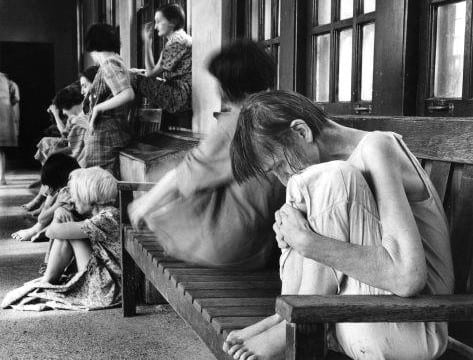
The reason I chose this picture is because we have been discussing mental asylums from women’s perspective. As we have discussed many women were put into these hospitals for less than solid reasons. I believe this picture perfectly shows the struggle and the feelings of hopelessness that patients felt.
11 October 2023

My roommate saw this on Reddit and sent it to me. I thought it was really funny, relatable, and topical to our class.
10/11/2023

Another meme about mental illness that shows that younger generations have become desensitized to the issue. It also reminds me of a comment I made earlier in the week about how sometimes people will take traits that are outside the norm and assume they have a mental illness or disorder. Szasz would not approve of this.
Mental Hygeine
Youtube clip History of Benzodiazepines
I thought this little short video on YouTube was interesting from Psychiatrist Allen Frances M.D. who says he was at the beginning of his training during the period when Benzodiazepines first appear in the early 1960s. He discusses what some of the thoughts and beliefs were about the drug as well as what was discovered about how the drug affected people after using it and becoming addicted to it.
Week Seven Resource Blog Post

Lately I’ve been trying to waste less time scrolling on Twitter and as a result have taken to wasting more time scrolling on Pinterest, which is where I found this really wonderful image of a My Little Pony character edited into what appears to be an old picture of a gate labeled “hospital for the insane.” While unfortunately I do not think that I will be able to work this into my project, it does tie into the larger question of what sort of reactions people have to the physical environment of historic psychiatric hospitals. Here, the punchline is both the literal and more subtextual juxtaposition between a bright image from a piece of children’s media and a darker image of something that overall has a negative connotation (since saving this, my Pinterest feed has been overtaken by similar memes, the majority of which I’ve seen using photos of dark y2k era bedrooms or, and this has been particularly interesting to me given my own area of study, pictures from around the Soviet Union). The brief discussion of popular references to lobotomies last class immediately made me think of this, and it also reminded me a lot of the jokes made about “Kirkbride core” images earlier in the semester with the sort of aestheticization of that era of mental health care.
(Week 7) Eastern State Lunatic Asylum (Lexington, KY)
https://asylumprojects.org/index.php/Eastern_State_Hospital_Lexington
This article provides a rough overview of the Eastern State Lunatic Asylum. The article is chronologically organized for the most part, which would help in establishing an understanding of the institution’s evolution. The Eastern State Lunatic Asylum was one of, if not, the most influential institution in the 19th and 20th centuries.
10/04/2023

This video reminded me of the readings for this week because it mentioned how in the 19th century insanity in women was linked to pregnancy and the period immediately after giving birth, which today we know is from the psychological stress of giving birth and is referred to as postpartum depression. The other part is the fact that women today usually do not expand or confess to having PPD for fear of being judged or institutionalized, which is something women in the 19th century can relate to as well.
Week 6 Blog Post
While working in my local Historical Society, I was shocked to find some things about Dr. Joseph DeJarnette who was Superintendent of the Western State Hospital. I found two different obituary’s about Dr. DeJarnette that seem very contradicting within my museum’s DeJarnette collection. This collection has some things that I believe would be beneficial for my research and project. -Jake Martin

