To supplement the readings for this week, I sought after a more basic overview of the treatment of women in mental institutions to serve as a brief summary of the material. This article, while a bit…. crass goes into some pretty interesting facts about how and why women were institutionalized. Also within the article is a video of patient life in these institutions.
Week Six Resource Blog Post
This news article from a week ago covers a story that, while I did not realize it at the time that I bookmarked it as a potential source for a post, mirrors many of the stories in Women of the Asylum quite heavily. A woman in Pennsylvania was committed to a psychiatric facility by her ex-boyfriend, who is a cop, based on false claims that she was suicidal. Similar to many of the stories told by 19th century women regarding being involuntarily committed to asylums, the ex-boyfriend used involuntary psychiatric treatment as a method of furthering abuse and, as part of his role as a cop, was able to do so due to a power imbalance in the relationship that meant his word held more weight than the victim’s and that he was able to make the decision to have her committed without thorough assessment of her mental state.
4 October 2023

I chose this meme because I saw it one day when I was scrolling on Instagram and immediately thought of this class. I thought it was funny that I saw something related to a mental health institute on one of my social media feeds.
History of Benzodiazepines Article
This is an interesting article from Benzodiazepine Information Coalition about the history of Benzodiazepines. https://www.benzoinfo.com/a-brief-history-of-benzodiazepines/
HMH Blog 2023-10-03 22:45:44
Initial Proposal and Bibliography
Joey Welch
Hist 471 History of Mental Health in the US
Dr. McClurken
Initial Proposal:
This research project focuses on several segregated and non-segregated asylums from the late nineteenth and early twentieth centuries. The central goals of the project are to examine the discrepancies in the institutions and asylum’s physical and social structures, their treatment methods, and patients’ overall experiences. This project sheds light on how the differences in many of these institutions were often strategically planned and racially motivated and how systemic racism in the field of medicine managed to seep through the 19th century into the 20th century.
Initial Bibliography
Bourque Kearin, Madeline. “‘As Syllable from Sound’: The Sonic Dimensions of Confinement at the State Hospital for the Insane at Worcester, Massachusetts.” History of Psychiatry 31, no. 1 (March 2020): 67–82. doi:10.1177/0957154X19879649.
Diana, Martha Louis. “Black Women’s Psychiatric Incarceration at Georgia Lunatic Asylum in the Nineteenth Century.” Journal of Women’s History 34, no. 1 (Spring, 2022): 26-48. doi:https://doi-org.umw.idm.oclc.org/10.1353/jowh.2022.0008. https://umw.idm.oclc.org/login?url=https://www-proquest-com.umw.idm.oclc.org/scholarly-journals/black-women-s-psychiatric-incarceration-at/docview/2811716628/se-2.
Goffman, Erving. “Asylums: Essays on the Social Situation of Mental Patients and Other Inmates” (1st ed.). Routledge. (2007). https://doi-org.umw.idm.oclc.org/10.4324/9781351327763
Gambino, Matthew. “Erving Goffman’s Asylums and Institutional Culture in the Mid-Twentieth-Century United States.” Harvard Review of Psychiatry 21, no. 1 (2013): 52–57. https://doi.org/10.1097/HRP.0b013e31827d7df4.
Foucault, Michel. History of Madness. London: Taylor & Francis Group, 2006. Accessed September 22, 2023. ProQuest Ebook Central.
Hughes, John S. “Labeling and Treating Black Mental Illness in Alabama, 1861-1910.” The Journal of Southern History 58, no. 3 (1992): 435–60. https://doi.org/10.2307/2210163.
Jackson, John P., and Nadine M. Weidman. “The Origins of Scientific Racism.” The Journal of Blacks in Higher Education 50, no. 50 (2005): 66–79.
McKinnon, Susan. “The American Eugenics Record Office: Technologies for Terminating ‘Degenerate’ Family Lines and Purifying the Nation.” Social Analysis 65, no. 4 (2021): 23–48. https://doi.org/10.3167/sa.2021.650402.
McGrath, Patrick. “Nonelective Surgery: In the Early 20th Century, Trenton State Hospital was the Scene of Unspeakable Experimental Treatments.” New York Times (1923-), May 29, 2005. https://umw.idm.oclc.org/login?url=https://www-proquest-com.umw.idm.oclc.org/historical-newspapers/nonelective-surgery/docview/92902465/se-2.
Norris, Caroline. “A History of Madness: Four Venerable Virginia Lunatic Asylums.” The Virginia Magazine of History and Biography 125, no. 2 (2017): 138–82. http://www.jstor.org/stable/26322605.
Nuriddin, Ayah. “Psychiatric Jim Crow: Desegregation at the Crownsville State Hospital, 1948–1970.” Journal of the History of Medicine & Allied Sciences 74, no. 1 (January 2019): 85–106. doi:10.1093/jhmas/jry025.
Oswald, Frances. “Eugenical Sterilization in the United States.” American Journal of Sociology 36, no. 1 (1930): 65–73. http://www.jstor.org/stable/2767224.
Payne, Christopher., and Oliver. Sacks. Asylum : Inside the Closed World of State Mental Hospitals. 1st ed. Cambridge: MIT Press, 2009.
Pumphrey, Shelby. “Curiously Cured by Sterilization.” Southern Cultures 29, no. 1 (2023): 74–105.
Reiss, Benjamin. Theaters of Madness Insane Asylums and Nineteenth-Century American Culture. Chicago: University of Chicago Press, 2008. https://doi.org/10.7208/9780226709659.
Royer, Steven Leigh. Allentown State Hospital. Mount Pleasant, South Carolina: Arcadia Publishing, 2020.
Stuckey, Zosha. “Race, Apology, and Public Memory at Maryland’s Hospital for the ‘Negro’ Insane.” Disability Studies Quarterly 37, no. 1 (2017). https://doi.org/10.18061/dsq.v37i1.5392.
Summers, Martin Anthony. Madness in the City of Magnificent Intentions : a History of Race and Mental Illness in the Nation’s Capital. New York, NY: Oxford University Press, 2019.
Summers, Martin. “‘Suitable Care of the African When Afflicted With Insanity’: Race, Madness, and Social Order in Comparative Perspective.” Bulletin of the History of Medicine 84, no. 1 (2010): 58–91. https://doi.org/10.1353/bhm.0.0320.
Week 6 post
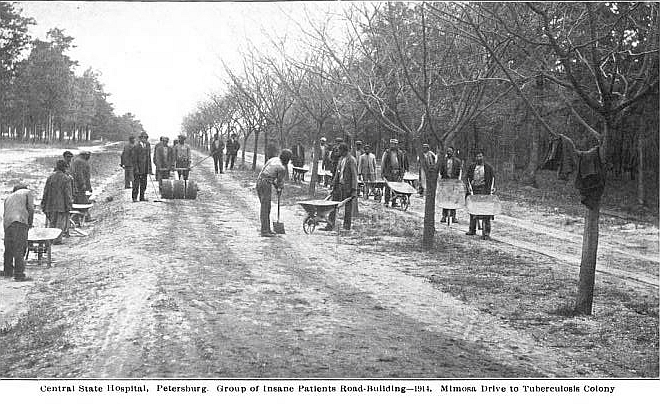
https://asylumprojects.org/images/9/9e/petersburg21.png
This image is from the Central State Hospital in Petersburg, Virginia. (More commonly known as the Central Lunatic Asylum) This image shows several African American “insane patients” building a road. This picture struck me initially because I thought the patients were doing field/agricultural work, which was one of the main methods supervisors and attendants used to occupy patient’s time. Putting African-American insane patients to work was seen as one of the better courses of action by institutions because they were deemed to be inherently and genetically inferior.
Women and Anxiety in the 1970s
I found this ad for Valium from Roche Laboratories in Everywoman magazine while searching for sources related to my topic on the marketing of anxiety drugs to women in the 1950s-1970. I think it is interesting that one anxiety women might experience which the ad is pointing towards is marriage as a main avenue of fulfillment in life.
SYLVIA HARTMAN, J.A., M.D.G., Emily Fishman, VARDA ONE, ANN, Madeline Belkin, et al. “Everywoman.” Everywoman 1, no. 1 (4) (July 10, 1970). https://jstor.org/stable/community.28036099.
Week 5 Blog Post
https://www.hmdb.org/m.asp?m=180205
In the Martin Summers reading towards the end, he mentions a little bit about one of the first Asylums dedicated solely to African Americans in Virginia. So I posted a link to a picture of the State Marker for the Asylum and it includes a brief little history which I found to be interesting. -Jake Martin
27 September 2023

I used this meme since I am researching Nellie Bly for my project and more often then not I get sucked into interesting YouTube videos I find about her. I honestly think Nellie Bly is really cool, so it’s really easy for me to get distracted while doing my research.
Week Five Resource Blog Post

I’ve been getting this really interesting ad on Twitter recently (please ignore the really poorly cropped screenshot; mobile is hard) that reminded me a bit of the blurry line between mental health treatment and spa treatment that we’ve mentioned a few times. I’m not totally sure in what way plunging oneself into a large bucket of ice water is to help one to fight anxiety and depression, but it immediately made me think of the idea of fixing an imbalance as a means of mental health treatment. I also looked at the website linked and was intrigued by the connection made between “wellness” and increased productivity within the workplace, with the motive for improving one’s mental and physical health being increasing their productivity at their job.