This video covers buildings in the Kirkbride plan, and references Dorthea Dix and other reformers who had a role on this plan.
Source List: Depictions of Mental Health in American Comedy
This was quite tricky to find a lot of good scholarly information on. There aren’t a lot of good monographs on this, and what exists seems to scarcely touch on how mental health has been seen through the comedic lens, so it would seem I’d have a lot of legwork to do if I keep on with this. In any case, for anyone curious (or Dr. McClurken, whom I assume may want to grade this, or something), here’s what I’ve found so far in Google Docs link form, so as to preserve the ever delightful hanging indent.
https://docs.google.com/document/d/139XtKkXMwEe_soYWI3nbcHhMhE-LEQdAEt5xL_nsWuA/edit?usp=sharing
Project Topic and Initial Bibliography
The topic that I am interested in pursuing for this project is what happened to the physical buildings of asylums during and following the period of deinstitutionalization. Were they abandoned, repurposed, torn down, etc? I am also curious as to how they were perceived within the community/wider public following that period and how understanding of these institutions may have impacted their fate and what sort of image they have currently by examining more contemporary discussions of former asylums in newspapers, etc.
The digital project that I am considering is a more traditional blog post/essay format that would incorporate images showing what these buildings looked like at their “prime” prior to deinstitutionalization and what they look like now. I also think this would be a good opportunity to implement video clips; there were a number of longer videos that I encountered both from official sources connected to the institutions and groups responsible for them and from unconnected lay people exploring former asylums that could be interesting to include parts of to see the various reactions to these spaces.
Bibliography:
Beitiks, Emily Smith. “The Ghosts of Institutionalization at Pennhurst’s Haunted Asylum.” Hastings Center Report, 42, no. 1 (January/February 2012): 22-24. Accessed September 11, 2023. https://web.s.ebscohost.com/chc/detail/detail?vid=0&sid=87264231-6d7e-4aff-9b37-7de8393a41e7%40redis&bdata=JnNpdGU9Y2hjLWxpdmU%3d#AN=82190459&db=cmh
Bresswein, Kurt. “Here’s a look at the Allentown State Hospital demolition, and what’s next (PHOTOS).” Lehigh Valley Live, December 24, 2020. Accessed September 11, 2023. https://www.lehighvalleylive.com/allentown/2020/12/heres-a-look-at-the-allentown-state-hospital-demolition-and-whats-next-photos.html
Cauvin, Henri E. “D.C. celebrates building opening at St. Elizabeths.” The Washington Post, April 23, 2010. Accessed September 11, 2023. https://www.washingtonpost.com/wp-dyn/content/article/2010/04/22/AR2010042204136.html
Cole, Jessica. “Forgotten Asylums; A Solemn History of Mental Health.” Abandoned Country, March 13, 2022. Accessed September 11, 2023. https://www.abandonedcountry.com/2022/03/13/forgotten-asylums-a-solemn-history-of-mental-health/
Exploring With Josh. “Exploring World’s Most Haunted Asylum | Terrifying Experience.” Youtube Video, 1:00:48. October 31, 2020. https://www.youtube.com/watch?v=4fOawW_4gaQ
Exploring With Josh. “Our Return To World’s Most Haunted Asylum (Gone Wrong).” Youtube Video, 1:09:37. September 11, 2022. https://www.youtube.com/watch?v=ykK0bHMmWgI
“Historic Site: The Public Hospital of 1773.” Colonialwilliamsburg.org, accessed September 11, 2023. https://www.colonialwilliamsburg.org/locations/public-hospital/
Holley, Joe. “Tussle Over St. Elizabeths.” The Washington Post, June 17, 2007. Accessed September 11, 2023. https://www.washingtonpost.com/wp-dyn/content/article/2007/06/16/AR2007061601192.html
Howard, Chris. “The Abandoned Eastern State Hospital – Williamsburg, Va.” Youtube Video, 2:30. January 31, 2022. https://www.youtube.com/watch?v=BidY1iq3bL4
Lael, Richard L., Barbara Brazos, and Margot Ford McMillen. Evolution of a Missouri Asylum : Fulton State Hospital, 1851-2006. Columbia: University of Missouri Press, 2007. Accessed September 11, 2023. https://ebookcentral.proquest.com/lib/umw/reader.action?docID=3570934&ppg=260
Lam, May-Ying. “New Life For Our Oldest Federal Psychiatric Facility.” NPR, May 3, 2010. Accessed September 11, 2023. https://www.npr.org/sections/pictureshow/2010/05/03/126475263/stliz
McNair, Dave. “ONARCHITECTURE- Erasing history: Wrecking ball aiming for DeJarnette?” The Hook 528. (July 2006). Accessed September 11, 2023. https://web.archive.org/web/20221220033820/https://readthehook.net/79628/onarchitecture-erasing-history-wrecking-ball-aiming-dejarnette
Moe, Richard. “A Disaster for St. Elizabeths.” The Washington Post, January 8, 2009. Accessed September 11, 2023. https://www.washingtonpost.com/wp-dyn/content/article/2009/01/07/AR2009010702977.html?nav=hcmoduletmv
Muschick, Paul. “Paul Muschick: Allentown State Hospital is gone, but its place in history will be preserved.” The Morning Call, December 23, 2020. Accessed September 11, 2023. https://www.mcall.com/2022/12/10/paul-muschick-allentown-state-hospital-is-gone-but-its-place-in-history-will-be-preserved/
Otto, Thomas. “St. Elizabeths Hospital: A History.” Washington, DC: United States General Services Administration, 2013. Accessed September 11, 2023. http://dcpreservation.org/wp-content/uploads/2013/05/0-COMPLETE-St.-Elizabeths-Hospital-A-History.pdf
Nelson, Alisa. “‘Finest Mental Hospital in U.S.’ Unveiled in Missouri.” Missourinet, May 23, 2019. Accessed September 11, 2023. https://www.missourinet.com/2019/05/23/finest-mental-hospital-in-u-s-unveiled-in-missouri/
Paulson, George W. “Closing the Asylums : Causes and Consequences of the Deinstitutionalization Movement.” Jefferson, NC: McFarland & Co, 2012.
The Proper People. “Exploring the Abandoned Allentown State Hospital – Amazing Asylum Architecture!” Youtube Video, 37:23. October 16, 2020. https://www.youtube.com/watch?v=8_1pkBEHNC4
Reischman, Collin. “In-depth: Inside of the deteriorating Fulton State Hospital.” The Missouri Times, August 26, 2013. Accessed September 11, 2023. https://themissouritimes.com/depth-inside-deteriorating-fulton-state-hospital/
Tomes, Nancy. “The Art of Asylum – Keeping: Thomas Story Kirkbride and the Origins of American Psychiatry (Studies in Health, Illness, and Caregiving).” Philadelphia: University of Pennsylvania Press, 1994.
Project Topic and Initial Bibliography
https://docs.google.com/document/d/1K7cO41Gb9pul82pQbHxXIeLMQq_vUj97gxkAe9HvBfg/edit?usp=sharing
Attached above is my Project Topic and Initial Bibliography. #histmental2023
Research Based Digital Project Broad Topic and Bibliography
Tenative digital project option: Digitally enhanced research essay
The evolvement of women’s reliance on treating anxiety with medications in the 1950s-1980s.
Bound, Fay. “Keywords in the History of Medicine: Anxiety.” The Lancet (British Edition) 363, no. 9418 (2004): 1407–.
Brill, Abraham, Signund, Freud. Selected Papers on Hysteria and Other Psychoneuroses. NY: The Journal of Nervous and Mental Disease Publishing Company 1912. Accessed September 11, 2023. https://archive.org/details/39002010893197.med.yale.edu/page/112/mode/2up
Bren, L. Frances Oldham Kelsey. FDA Medical Reviewer Leaves Her Mark on History. FDA Consumer. Vol. 35. United States: Superintendent of Documents, 2001. https://umw.primo.exlibrisgroup.com/permalink/01UMW_INST/1mko5a7/cdi_proquest_miscellaneous_227053184.
Branch, Hardin, Charles .H. Aspects of Anxiety. Philadelphia, Lippincott 1968. Accessed September 11, 2023 https://archive.org/details/aspectsofanxiety00bran/mode/2up.
Brinkley, David. “Segment 3 (Women, Moods, and RX Drugs) # 498936.” Vanderbuilt News Archive. Accessed September 11, 2023. https://tvnews.vanderbilt.edu/broadcasts/498936
Coontz, Stephanie. The Way We Never Were : American Families and the Nostalgia Trap. Revised and updated edition, 2016 edition. New York: Basic Books, a member of the Perseus Book Group, 2016.
Diamond, Edwin. “Looking at Young Wives with Brains.” Newsweek 55, (1960): 94-95. Accessed September 11, 2023. https://archive.org/details/newsweek55jannewy/page/n1127/mode/2up?q=Edwin.
Greene, Jeremy A. “Hidden in Plain Sight Marketing Prescription Drugs to Consumers in the Twentieth Century”. Am J Public Health (May 2010), 793-803. Accessed September 11, 2023. https://www.ncbi.nlm.nih.gov/pmc/articles/PMC2853635/
HOUCK, JUDITH A. “‘What Do These Women Want?’: Feminist Responses to ‘Feminine Forever’, 1963-1980.” Bulletin of the History of Medicine 77, no. 1 (2003): 103–32. https://doi.org/10.1353/bhm.2003.0023.
Lutz, Tom. American Nervousness, 1903 : an Anecdotal History. Ithaca: Cornell University Press, 1991. https://www.proquest.com/docview/136587625/8BF2DE68BA654300PQ/72?accountid=12299
LOPEZ-MUNOZ, Francisco, Cecilio ALAMO, and Pilar GARCIA-GARCIA. “The Discovery of Chlordiazepoxide and the Clinical Introduction of Benzodiazepines: Half a Century of Anxiolytic Drugs.” Journal of Anxiety Disorders 25, no. 4 (2011): 554–62. https://doi.org/10.1016/j.janxdis.2011
Metzl, Jonathan. Prozac on the Couch : Prescribing Gender in the Era of Wonder Drugs. Durham: Duke University Press, 2003.
Metzl, Jonathan M. “‘Mother’s Little Helper’: The Crisis of Psychoanalysis and the Miltown Resolution.” Gender & History 15, no. 2 (2003): 228–55. Accessed September 11, 2023 https://doi.org/10.1111/1468-0424.00300.
Shorter, Edward. A Historical Dictionary of Psychiatry. New York: Oxford University Press, 2005.
Shorter, Edward. A History of Psychiatry: From the Era of the Asylum to the Agre of Prozac. NY: John Wiley & Sons 1997. Accessed September 11, 2023. https://archive.org/details/historyofpsychia0000shor_i2e8
Stephens, Trent D., and Rock Brynner. Dark Remedy : the Impact of Thalidomide and Its Revival as a Vital Medicine. Cambridge, Mass: Perseus Pub., 2001.
SYLVIA HARTMAN, J.A., M.D.G., Emily Fishman, VARDA ONE, ANN, Madeline Belkin, et al. “Everywoman.” Everywoman 1, no. 1 (4) (July 10, 1970). https://jstor.org/stable/community.28036099.
Tone, Andrea, and Elizabeth Siegel Watkins. Medicating Modern America. NY: NYU Press 2007. Accessed September 11, 2023. https://web-s-ebscohost-com.umw.idm.oclc.org/ehost/detail/detail?vid=0&sid=c46e2534-f251-4005-b027-a88b8cbbef6d%40redis&bdata=JnNpdGU9ZWhvc3QtbGl2ZSZzY29wZT1zaXRl#AN=200949&db=nlebk.
Tone, Andrea. “Listening to the Past: History, Psychiatry, and Anxiety.” The Canadian Journal of Psychiatry—In Review 50, no.7 (June 2005): 373-80. Accessed September 11, 2023. https://journals.sagepub.com/doi/pdf/10.1177/070674370505000702.
Woloch, Nancy. Women and the American Experience. 3rd ed. Boston: McGraw-Hill, 2000.
Project Sources
I didn’t want to post the citations directly, as WordPress isn’t playing nice with my formatting.
Bibliography and Topic
Project Topic-Diet culture and its influence on eating disorders in the 21st century
Biederman , Alyssa. My Rory: A Personal Journey Through Teenage Anorexia. Lincoln, NE: iUniverse, 2005.
Binstock, Melissa. Nourishment: Feeding My Starving Soul When My Mind and Body Betrayed Me. Deerfield Beach: Health Communications, Inc., 2001.
Burns, Maree, and Helen Malson. Critical Feminist Approaches to Eating Dis/orders. New York: Routledge, 2009. https://doi.org/10.4324/9780203876442.
Chaerani, Astrid Restu, and Junaidi Junaidi. “DOES DIET START TOMORROW? A DISCOURSE ANALYSIS OF SELF-DEPRECATING HUMOR AGAINST DIET CULTURE IN DIET STARTS TOMORROW.” Celtic (Online) 6, no. 2 (2019): 51–62.
Doney, Faith M, Jonathan Lee, Ani Sarkisyan, Emilio J Compte, Jason M Nagata, Eric R Pedersen, and Stuart B Murray. “Eating Disorder Risk Among College Sorority and Fraternity Members Within the United States.” Eating Disorders 31, no. 5 (2023): 440–49. https://doi.org/10.1080/10640266.2023.2188005.
Halban, Emily. Perfect: Anorexia and Me. London: Vermilion, 2008.
Hansen, Kathryn. Why I Was Bulimic, Why Conventional Therapy Didn’t Work, and I Recovered For Good. Phoenix: Camellia Publishing, 2011.
Hornbacher, Marya. Wasted: A Memoir of Anorexia and Bulimia. New York: Harper Collins, 1999.
Howward-Taylor, Lucy. Biting Anorexia: A Firsthand Account of an Internal War. Oakland, CA: New Harbinger Publications, 2009.
Kingsley, Jo and Alice. Alice in the Looking Glass: A Mother and Daughter’s Experience of Anorexia. London: Piatkus Books, 2005.
Knopp, Lisa. Bread : a Memoir of Hunger. Columbia: University of Missouri Press, 2016.
McKay, George. “Skinny Blues: Karen Carpenter, Anorexia Nervosa and Popular Music.” Popular Music 37, no. 1 (2018): 1–21. https://doi.org/10.1017/S026114301700054X.
Pettit, Christie. Empty: A Story of Anorexia. Grand Rapids, MI: Revell, 2006.
Rivera, Erica. Insatiable: A Young Mother’s Struggle with Anorexia. New York: Berkley, 2010.
Rozgonjuk, Dmitri, Johanna Ignell, Franziska Mech, Eva Rothermund, Harald Gündel, and Christian Montag. “Smartphone and Instagram Use, Body Dissatisfaction, and Eating Disorders: Investigating the Associations Using Self-Report and Tracked Data.” Journal of Eating Disorders 11, no. 1 (2023). https://doi.org/10.1186/s40337-023-00865-1.
Sacker, Ira M., and Marc A. Zimmer. Dying to Be Thin. New York, NY: Warner Books, 1987.
Sole-Smith, Virginia. The Eating Instinct: Food Culture, Body Image, and Guilt in America. New York: Henry Holt and Company, 2018.
Swenson, Rae. Linger No Longer: A Memoir of Anorexia. Charleston, SC: Booksurge Publishing, 2009.
Way, Karen. Anorexia Nervosa and Recovery : a Hunger for Meaning. New York: Routledge, 2013. https://doi.org/10.4324/9781315820668.
Zipfel, Stephan, Andreas Stengel, Stephan Zipfel, Andreas Stengel, and Katrin Giel. Anorexia Nervosa. Basel, Switzerland: MDPI – Multidisciplinary Digital Publishing Institute, 2021.
-9/10/23
Week 1
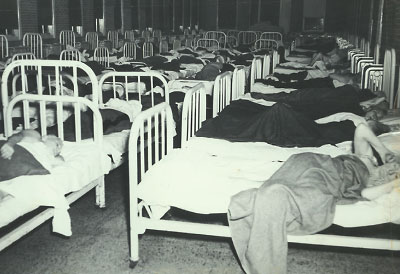
This photo shows the “bedroom” of an American psychiatric hospital in 1861. It perfectly displays the poor conditions we have discussed this week. Specifically issues of overcrowding as we can see the room is completely full of beds with narrow walkways. The overall lack of privacy speaks to how patients were continually dehumanized throughout hospitals.
Overcrowding in Crownsville (week 2 post)
https://i.pinimg.com/236x/21/57/97/2157979884e336e409bc085351a76fba–mental-asylum-insane-asylum.jpg
When I first looked at this picture, I wasn’t quite sure what I was looking at. After a little digging and found out that the picture came from what was then called the “Hospital for the Negro Insane of Maryland.” (founded in 1910) We haven’t discussed asylum treatment of minorities very much in class, but our conversation today was a lot more about progress and optimism in the field of medicine in the early stages of the asylum, and this picture provides a stark contrast to the conversations we were having. What is hard to shake is how cramped those in the picture look and the fact that many of them are sleeping on the floor. This picture represents the neglect and mistreatment that was present even in an era of reformation. It also leaves me with a sickening feeling of anticipation for our conversations about the care or lack thereof of minorities with mental illness. #HMH #histmental2023 #mentalhealthmatters
The Xanax Story
Okay, so bear with me. As someone who’s tried their hand at comedy (to varying degrees of success), and someone who enjoys history, I’ve long been fascinated with the development of humor and satire in the United States. I’ve been trying to figure out how to sneak this casual fascination into a class/scholarly pursuit for some time, and I think I may have found my angle. Mental health is arguably more widely discussed than ever before, and with that greater societal understanding, acceptance, and discussion comes–you guessed it, comedy.
On that note, I’d like to share a clip from a stand-up special, New In Town, by John Mulaney. Mulaney is probably one of the better known stand-ups for younger people, and I think much of that is due to his repeatability of his material. To wit, I include “The Xanax Story,” where Mulaney recounts his experience trying to get a prescription for the anti-anxiety drug to in a way, self-medicate, his anxiety. It reminded me of Tone’s writing on tranquilizers, and the common desires of both patients and professionals for quick solutions. It also gets into themes of substance abuse that I presume we might touch on later in the semester. At the very least, I think its a funny routine (its a bit crass; if someone like Jim Gaffigan is more your speed, you may not like it). In any case, I hope it makes you laugh just a bit, and think about how society sees medication and treatment for metal disorders.

