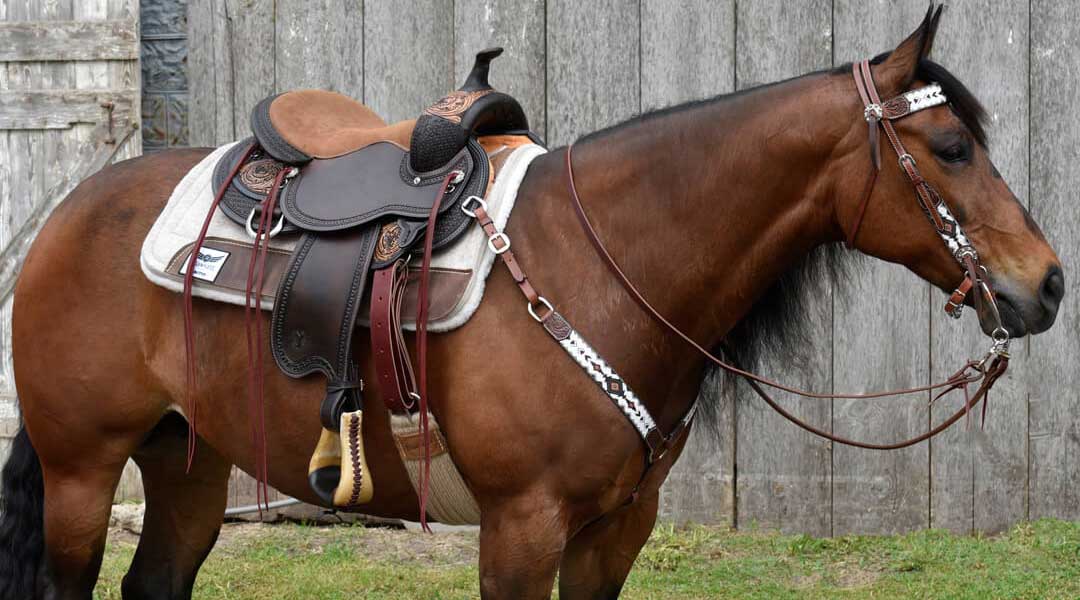
Artifact’s Antecedents
The development of the Western saddle has a rich and complex history of antecedents. Its roots can be traced as far back as around 3000 BC, when the first use of horses was recorded in Mesopotamia.1 Since then, horses and their equipment have appeared in countless accounts across the world, with the exception of the Americas, where horses were reintroduced by Spanish conquistadores at the end of the fifteenth century. 2
Given the complexity of this history, our group has chosen to focus on the most relevant antecedents of the Western saddle in the eighteenth and nineteenth centuries, while excluding examples from the European Middle Ages, the Asian steppes, and other traditions. In particular, we consider two types of colonial Spanish saddles, the Mexican vaquero saddle, and the English flat saddle.
The estradiota was a heavy combat saddle suited for long hours of riding but lacking agility, which led some conquistadores and settlers to prefer the jineta, a lighter and more maneuverable design adapted from Arabic models during the Reconquista. 3 By the nineteenth century, the modified jineta evolved into the Mexican vaquero saddle, featuring the “Spanish Tree” and removable parts like the mochila and anquera. Alongside this, the English flat saddle with its lighter tree, closer leg contact, and metal reinforcements also influenced the Western saddle.4
Taken together, these four antecedents shaped the Western saddle, which emerged as a culmination of diverse technological traditions adapted to the needs of the American frontier.
Invention
The invention of the western saddle can be difficult to pinpoint.. While the earliest example we have of a saddle was found inside a tomb in modern day China and believed to have been created around 500 BCE. 5Though this particular saddle is a far cry from the western saddle of today, as it’s little more than two pads attached together to provide a bit of cushion for the rider. Since then, we have come a long way in saddle development with many innovations and changes. This raises the question, when and why the “western saddle” as we know it today was invented? We can trace the origin of similar saddles to the 1600’s in Mexico. Where modifications were made to their saddles to be better suited for field and hand work.6 As people began to ride longer and further, these saddles began to grow in size to increase comfort. As this design spread throughout the Americas many craftsmen made their own modifications, including adding a hole to reduce weight as the saddles grew even larger. Many of these modifications were adopted or rejected in the greater picture of saddle development. Due to this, many different variations of saddle could be found throughout the south during the 18th and 19th centuries. Sharing the same general features but with their own slight differences. Such as the pony express saddle, a lightweight saddle made to be ridden by small riders for speed and distance. 7In conclusion, the western saddle was not an invention by one man but that of a community over hundreds of years, or thousands if one considers this beginning so many years ago in China. Embarking on a journey that would slowly evolve until it found its own unique features.
Possible Alternatives
During early America, horseback riders employed a variety of saddles before the widespread adoption of the western stock saddle after the Civil War. In the eastern United States, English saddles were common and influenced hybrid models developed on the frontier because they were lightweight designs suited for hunting and racing.8 Mexican and Spanish traditions provided another crucial alternative. The silla vaquera and regional variants, such as the ornate charro and skeletal open-tree saddles, shaped equestrian practice in the United States; their durable trees became the basis for American stock and military saddles. 9 Similarly, the U.S. military experimented with alternatives before the McClellan model of 1859, including the Grimsley dragoon saddle and the Hope saddle of Texas manufacture, which both borrowed heavily from Mexican prototypes.10 Indigenous traditions offered further variation. Native Americans in the Plains used pad saddles, which were treeless, stuffed cushions often decorated with beadwork, as well as frame saddles consisting of wooden pommels and cantles joined by rawhide-covered sideboards.11 In situations of scarcity, buffalo hide pads strapped to a horse’s back could substitute for manufactured saddles.12 The modern American western saddle emerged after 1865 as a synthesis of these traditions, but these alternatives did not disappear. It drew most directly from the Mexican vaquero saddle, especially its strong “Spanish tree” and horn designed for roping cattle. By the third quarter of the nineteenth century, the U.S. stock saddle became distinctive for its swelled pommel shoulders, high dished cantle, centered rigging, and durable leather skirts. 13Its spread coincided with the rise of cattle ranching in Texas and the Great Plains, where it proved superior for long hours of range work and roping. Popularized by cowboys and reinforced through saddle-making centers in Texas and Oregon, it became the dominant equestrian technology of the American West and a cultural symbol of frontier identity. However, variations and alternatives are still readily available and popularity is dependent on geographic location.
Interaction with American Society and Culture
The western saddle is deeply embedded in the historical fabric of American history. Its usage, paired with the horse-drawn wagon, is responsible for the earliest large-scale locomotion which equipped pioneers and pilgrims to explore the vast stretches of American wilderness. Today, technology rushes forward to faster and more efficient modes of transport. The tradition of saddle-making, however, has not stagnated in irrelevancy. “Companies that have deep enough pockets for research and development will always be innovating and developing new concepts,” 14 Christian Lowe, a modern saddler, proclaims. Much to the same extent, Clarence Percifield claimed in 1896, nearly two centuries ago, claims in a patent that his design of saddle “has for its object to simplify and… increase its durability.” 15John Hasting rushed his own patent to the government five years later in 1901, claiming that “the same is to provide a… strong and durable construction.”16 These two men are not the only of a flock of inventors who were eager to innovate. The unique complexity of the saddle provides it the potential for numberless modifications, especially as models evolve far from their beginning with spanish or english saddles. Americans had to navigate a treacherous land without roads and hilly terrain. “Since then, saddles continue to evolve,” 17Tania Millen writes for HorseJournals. Though not for the same journeys as before, the saddle retains its evolutionary advantages and cultural presence in America.
WordPress Structure
All group members now possess editorial access to the project site. Our design will follow the structure of prior groups, which feature a home page introducing the project and its creators, along with navigable pages on the western saddle’s antecedents, development, impact, legacy, key figures, and locations. Additional pages will host our documentary and bibliography for easy access. We do not intend to use generative artificial intelligence for any aspect of the site-building process. Prior enrollment in digital studies courses, a basic understanding of WordPress, and a familiarity with the UMW Digital Knowledge Center enable us to build this website independently of AI.
Documentary Structure
Our team has decided to include an example of the western saddle in order to clearly demonstrate its fundamental parts and trace their historical development. By showing the object directly, we hope to provide our audience with a practical sense of how the western saddle was constructed and how its design evolved from earlier antecedents. In addition, we plan to interview members of the UMW equestrian team to gain some substantial insights not only into the use of Western saddles but also into how they compare with other types of saddles still in use today. We intend to visit and document equestrian equipment preserved in a historical manor, such as Kenmore House, to highlight how such objects were integrated into daily life and culture. Overall, our project will combine object display, interviews, and on-site filming in historically relevant locations.
Annotated Bibliography
- Beatie, Russel H. Saddles. Norman: University of Oklahoma Press, 1981.
Beatie provides a detailed historical study of saddles. He focuses on their development, design, and cultural significance across time. - Dorsey, R. Stephen, and Kenneth L. McPheeters. The American Military Saddle, 1776–1945. Fort Collins, CO: Collectors’ Library, 1999.
This book traces the evolution of U.S. military saddles. It documents styles, uses, and the role of saddlery in military history. - Hastings, John Reed, and Clarence Brooks Hastings. “Saddle, Patent for a Western Style Equestrian Saddle.” U.S. Patent 709,904, September 23, 1902. The Portal to Texas History.
This patent describes a design innovation for the western saddle. - Hutchins, Dan, and Sebie Hutchins. Old Cowboy Saddles & Spurs: Identifying the Craftsmen Who Made Them. 6th ed. Horsefeathers Ranch, 1996.
This documents regional saddle makers and spur craftsmen. - Livingston, Phil. Cavalcade of American Saddles. Page Publishing, 2022.
Livingston surveys the history and variety of American saddles and highlights their role in culture and equestrian tradition. - Percifield, Clarence W. “Riding-Saddle.” U.S. Patent, November 17, 1896. The Portal to Texas History.
This late 19th-century patent showcases technical modifications to saddle construction. - Reynolds, Bill. The Art of the Western Saddle: A Celebration of Style and Embellishment. New York: Simon & Schuster, 2005.
Reynolds highlights the artistry and craftsmanship of western saddles and focuses on decorative traditions and stylistic evolution. - Rice, Lee M., and Glenn R. Vernam. They Saddled the West. Cambridge, MD: Cornell Maritime Press, 1975.
Rice and Vernam narrate the history of western saddles, and explore their origins, functions, and cultural impact in American history. - Risner, Genevene. Parts of a Western Saddle and the Variations. Buffalo Bill Center of The West. August 20th 2021, https://centerofthewest.org/2021/08/20/parts-of-a-western-saddle-and-the-variations/#:~:text=How%20does%20a%20Western%20saddle,roping%20and%20other%20ranch%20activities. (Accessed Sept 24th, 2025)
This article explains the components of a western saddle and discusses how different variations support specific ranching and riding activities. - Ahlborn, Richard E., ed. Man-Made Mobile: Early Saddles of Western North America. Smithsonian Studies in History and Technology, no. 39. Washington, DC: Smithsonian Institution, 1980.
This edited volume examines archaeological and historical evidence of early saddles in North America, situating them within broader cultural and technological contexts. - Stoecklein, David R. Saddles of the West: History, Art, Culture, Function. Cowboy Gear Series. Stoecklein Publishing, 2005.
Stoecklein combines historical narrative with visual documentation to show how western saddles reflect both utility and artistry. - Stohlman, Al, and Ann Stohlman. The Stohlman Encyclopedia of Saddlemaking. Tandy Leather Co., 1993.
This encyclopedia offers a practical guide to saddlemaking techniques that is intended for both beginners and professional craftsmen. - Wertmann, Patrick, et al. “The Earliest Directly Dated Saddle for Horse-Riding from Mid-1st Millennium BCE Female Burial in Northwest China.” Archaeological Research in Asia, vol. 35, Sept. 2023, p. 100451. ScienceDirect, https://doi.org/10.1016/j.ara.2023.100451.
This peer-reviewed study reports the discovery of the oldest directly dated saddle and provides evidence of early horse-riding practices in ancient China. - Winegar, Daniel. New Materials and Methods for Western Saddlery. Master’s thesis, University of Oregon, 2022. Scholars’ Bank.
Winegar’s thesis explores innovations in saddle construction, testing new materials, and techniques for modern saddlery. - “Saddlery — Old Profession, New Innovations.” Horse Journals. By Tania Millen, B.Sc., M.J., July 17, 2024. https://www.horsejournals.com.
This article discusses the modern saddlery industry which balances its deep traditions with new technologies and materials.
- Russel H. Beatie, Saddles (Norman: University of Oklahoma Press, 1981), 7.
 ︎
︎ - Beatie, Saddles, 8.
︎ - Richard E. Ahlborn, ed., Man Made Mobile: Early Saddles of Western North America, Smithsonian Studies in History and Technology, no. 39 (Washington, DC: Smithsonian Institution Press, 1980), 18, 41.
︎ - Ibid., 18.
︎ - Wertmann, “The Earliest Directly Dated Saddle for Horse-Riding from Mid-1st Millennium BCE Female Burial in Northwest China”
︎ - Alborne, “Man Made Mobile” 30-31 ︎
- Genevene, “Parts of a Western Saddle and the Variations“
︎ - Richard E. Ahlborn, ed., Man Made Mobile: Early Saddles of Western North America, Smithsonian Studies in History and Technology, no. 39 (Washington, DC: Smithsonian Institution Press, 1980), 39.
︎ - Ahlborn, Man Made Mobile, 21-23.
︎ - James S. Hutchins, “Western Saddles Before the Cowboy,” in Man Made Mobile: Early Saddles of Western North America, ed. Richard E. Ahlborn, Smithsonian Studies in History and Technology, no. 39 (Washington, DC: Smithsonian Institution Press, 1980), 39–45. ︎
- John C. Ewers, “Saddles of the Plains Indians,” in Man Made Mobile: Early Saddles of Western North America, ed. Richard E. Ahlborn, Smithsonian Studies in History and Technology, no. 39 (Washington, DC: Smithsonian Institution Press, 1980), 72–74.
︎ - Ewers, “Saddles of the Plains Indians,” 73.
︎ - Ahlborn, Man Made Mobile, 18-19. ︎
- Winegar, Daniel. New Materials and Methods for Western Saddlery. University of Oregon, June 2022. (Scholars’ Bank)
︎ - Percifield, Clarence W. “Riding-Saddle.” U.S. Patent, Nov. 17, 1896. (The Portal to Texas History)
︎ - Hastings, John Reed & Hastings, Clarence Brooks. “Saddle, patent for a western style equestrian saddle.” U.S. Patent No. 709,904 (1902). (The Portal to Texas History)
︎ - “Saddlery – Old Profession, New Innovations.” Horse Journals, Tania Millen, B.Sc., M.J., July 17, 2024. (Horse Journals)
︎
 , offers a fascinating case study in American technology and culture. At once a story of discovery, accident, and industrial transformation, polystyrene embodies the promise and the peril of modern innovation. Its history begins in the nineteenth century, develops through wartime necessity in the twentieth, and continues to shape economic, cultural, and environmental debates in the twenty-first. Our project will trace this material from its earliest antecedents to its present controversies, showing how one substance could so deeply influence American life.
 , offers a fascinating case study in American technology and culture. At once a story of discovery, accident, and industrial transformation, polystyrene embodies the promise and the peril of modern innovation. Its history begins in the nineteenth century, develops through wartime necessity in the twentieth, and continues to shape economic, cultural, and environmental debates in the twenty-first. Our project will trace this material from its earliest antecedents to its present controversies, showing how one substance could so deeply influence American life.