Documentary Bibliography

Barnes, Rhae Lynn. “Working Class Hero to Felon: Picking Apart the Banjo’s Cinematic Character Assassination in Postwar Mass Culture and Film.” Modern American History 7, no. 2 (July 1, 2024): 313–18. Working Class Hero to Felon: Picking Apart the Banjo’s Cinematic Character Assassination in Postwar Mass Culture and Film | Modern American History | Cambridge Core

Blount, Jake. “Jail the Zombie: Black Banjoists, Biopolitics, and Archives.” Modern American History 7, no. 2 (July 2024): 301–6. https://doi.org/10.1017/mah.2024.30

Conway, Cecelia. “Black Banjo Songsters in Appalachia.” Black Music Research Journal 23, no. 1/2 (2003): 149–66. https://doi.org/10.2307/3593213

Dubois, Laurent. The Banjo : America’s African Instrument. Cambridge, Massachusetts: The Belknap Press of Harvard University Press, 2016.

Fulwood, Ethan L. “Quantitative Similarities between the Banjo and a Diverse Collection of West African Lutes.” Humanities & Social Sciences Communications 9, no. 1 (2022). https://doi.org/10.1057/s41599-022-01401-3

Khalid, Farisa. “Henry Ossawa Tanner, The Banjo Lesson.” September 9, 2016. Accessed September 19, 2025. https://smarthistory.org/tanner-banjo/

Pilgrim, David. “Who Was Jim Crow?” Jim Crow Museum, September, 2000, https://jimcrowmuseum.ferris.edu/who/index.htm

Stimeling, Travis D. “Well of Souls: Uncovering the Banjo’s Hidden History by Kristina R. Gaddy (Review).” Notes (Music Library Association) 80, no. 2 (2023): 346–48. https://doi.org/10.1353/not.2023.a912355

Thompson, Joseph M. “Five Strings for Freedom: The Banjo in Cold War America.” Modern American History (Cambridge.) 7, no. 2 (2024): 307–12. https://doi.org/10.1017/mah.2024.32

Thornton, Ramsey. “Affrilachian Banjo Lineage: Its Archaeological Trail, Instances of Black/White Exchange, and Lasting Legacy.” Order No. 30575206, Oklahoma State University, 2023. https://umw.idm.oclc.org/login?url=https://www.proquest.com/dissertations-theses/affrilachian-banjo-lineage-archaeological-trail/docview/2910062412/se-2

Winans, Robert B, and Elias J Kaufman. “Minstrel and Classic Banjo: American and English Connections.” American Music (Champaign, Ill.) 12, no. 1 (1994): 1–30. Minstrel and Classic Banjo: American and English Connections on JSTOR 

B- Roll Sources

(Listed in order of appearance)

World Bluegrass Day. “PBS Arts: Give Me the Banjo (2011).” December 13, 2024. https://www.youtube.com/watch?v=gkmKzf99EjY.

Bluegrass Country Soul. “Earl Scruggs “Foggy Mountain Breakdown” with JD Crowe Bill Emerson Sonny Osborne and More.” December 27, 2021. https://www.youtube.com/watch?v=af9wHDrkjfk 

Craft in America. “Banjo maker Jim Hartel on the African heritage and American history of the banjo.” October 30, 2015. https://www.youtube.com/watch?v=VbCjb6g-bT4

Visual Melodies. “Appalachian Bluegrass Banjo & Fiddle Music | Uplifting Happy Music | 🚫ADS.” September 13, 2022. https://www.youtube.com/watch?v=g4R936oEuH4

Tracy Newman. “Cripple Creek” with Tracy Newman on the 5-string banjo.” August 11, 2015. https://www.youtube.com/watch?v=Ew6DS2bXYmk

“The Humble Genius Of Earl Scruggs.” Southern Songs and Stories, 2023. https://www.southernsongsandstories.com/blog/2023/1/23/the-humble-genius-of-earl-scruggs 

Grossman, Sid. n.d. Pete Seeger Photograph. National Portrait Gallery, Smithsonian Institution. Accessed October 16, 2025. https://www.si.edu/object/pete-seeger:npg_NPG.94.85

LeDonne, Rob, “Steve Martin Explains His Love of Banjo Music: ‘It Rivals Any Specialized Genre,” Billboard, August 10, 2017, https://www.billboard.com/music/country/steve-martin-banjo-prize-interview-7897956/

Annie Spratt. “A Field With Trees and Clear Sky.” June 25, 2025. https://unsplash.com/photos/a-field-with-trees-and-clear-sky-WMYGNv7G7_E

Scott V. Linford. “Stories of Differentiation and Association: Narrative Identity and the Jola Ekonting.” Yearbook for Traditional Music 48 (2016): 94–114. https://doi.org/10.5921/yeartradmusi.48.2016.0094.

Sora Ngoni (Simbingo). 19th century. Gourd, skin, wood, leather, 88cm x 31cm x 27cm. The Metropolitan Museum of Art. Open: The Metropolitan Museum of Art. Artstor. https://jstor.org/stable/community.27235563

Maker: Mamadou Kouyaté (d. 1991) (bridge by Djimo Kouyaté). Kora. ca. 1960. Gourd, goat skin, antelope-hide, ebony, metal, wood, 45 9/16 × 20 11/16 × 17 in. (115.8 × 52.5 × 43.2 cm). The Metropolitan Museum of Art; Musical Instruments; Rogers Fund, 1975. https://jstor.org/stable/community.15645144.

Aymeric Inspiration Prod Gardey. “African Griots Live.” April 13, 2007. https://www.youtube.com/watch?v=zQMFN-whbEU 

Paul Draper. “Koromanti #1.” June 27, 2023. https://www.youtube.com/watch?v=ffU8jknBzzM

Created by Unidentified. Gourd Head Banjo. ca. 1859. Gourd with wood and metal, H x W x D: 7 × 26 1/2 × 2 1/2 in. (17.8 × 67.3 × 6.4 cm). National Museum of African American History and Culture; Collection of the Smithsonian National Museum of African American History and Culture. https://jstor.org/stable/community.31886663

Seutter, Matthew. “Map of the New World, with European settlements and American Indian tribes, 1730.” The Gilder Lehrman Institute of American History. https://www.gilderlehrman.org/history-resources/spotlight-primary-source/map-new-world-european-settlements-and-american-indian

“Stewart Five-String Banjo | Smithsonian Institution.” 2025. Si.edu. 2025. https://www.si.edu/object/stewart-five-string-banjo:nmah_605689

“Gibson Tenor Banjo | Smithsonian Institution.” 2025. Si.edu. 2025. https://www.si.edu/object/gibson-tenor-banjo:nmah_606326

Bluegrass Preservation. “The Darlings – Dooley.” June 21, 2012. https://www.youtube.com/watch?v=oELWmTVR_j4

I Dream of Jeanie, directed by Allan Dwan (United States; Republic Pictures, 1952), https://www.youtube.com/watch?v=6NqbxQw0rdY

Childe, J.W., and Meyer, H. Portrait of Thomas Dartmouth Rice. n.d. Sheet 8 1/2 x 11 3/8 inches. University of Illinois Theatrical Print Collection; Portraits of Actors, 1720-1920, University of Illinois Library. University Library (University of Illinois at Urbana-Champaign). Artstor. https://jstor.org/stable/community.12279635.

Pendleton. Thomas Dartmouth Rice as Jim Crow. n.d. Tinted rectangle  5 5/8 x 8 1/4 inches. University of Illinois Theatrical Print Collection; Portraits of Actors, 1720-1920, University of Illinois Library. University Library (University of Illinois at Urbana-Champaign). Artstor. https://jstor.org/stable/community.12277836.

Ikachina. “Jump Jim Crow – Blackface Song and Dance — Extended Version.” Jul 19, 2022. https://www.youtube.com/watch?v=FKzTaZLEKd4.

London: City Map. 1812. https://jstor.org/stable/community.13562185

Winans, Robert B, and Elias J Kaufman. “Minstrel and Classic Banjo: American and English Connections.” American Music (Champaign, Ill.) 12, no. 1 (1994): 1–30. Minstrel and Classic Banjo: American and English Connections on JSTOR

“Taylor Swift—Grammys 2012 Performance!” Just Jared Jr, February 14, 2012, https://www.justjaredjr.com/2012/02/14/taylor-swift-grammys-2012-performance/?photomorehere 

“Darius Rucker: “Wagon Wheel” At New Year’s Eve Live: Nashville’s Big Bash” Darius Rucker January 3, 2022 https://www.bing.com/videos/riverview/relatedvideo?q=darius+rucker+wagon+wheel+at+new+years&&mid=46CA6F46DE56D775936946CA6F46DE56D7759369&FORM=VAMGZC

“Dolly Parton Apple Jack” Dean Hammons February 8, 2009 https://www.bing.com/videos/riverview/relatedvideo?&q=dolly+parton+apple+jack&&mid=2CA2ECCEACD91AB2933C2CA2ECCEACD91AB2933C&&FORM=VRDGAR

“Don Flemmons – In the Jailhouse Now” Don Flemmons October 15, 2013 https://www.bing.com/videos/riverview/relatedvideo?q=don+flemmons+in+the+jailhouse+now&mid=774ECB8E92CACFA54083774ECB8E92CACFA54083&FORM=VIRE

“Rhiannon Giddens Julie ” Macfoto February 11, 2015 https://www.bing.com/videos/riverview/relatedvideo?q=rhiannon+giddens+julie&mid=1FAF696D83D9CB75FED81FAF696D83D9CB75FED8&FORM=VIRE

“Amythyst Kiah – Darling Cora” July 5, 2014. https://www.youtube.com/watch?v=ovzdZLXWnIg

Rhiannon Giddens & Justin Robinson – John Henry Rhiannon Giddens & Nonesuch Records April 16, 2025https://www.bing.com/videos/riverview/relatedvideo?q=rhiannon+giddens+and+justin+robinson&mid=CD59BEDB430416F81323CD59BEDB430416F81323&FORM=VIRE
The Legacy of the Cassette

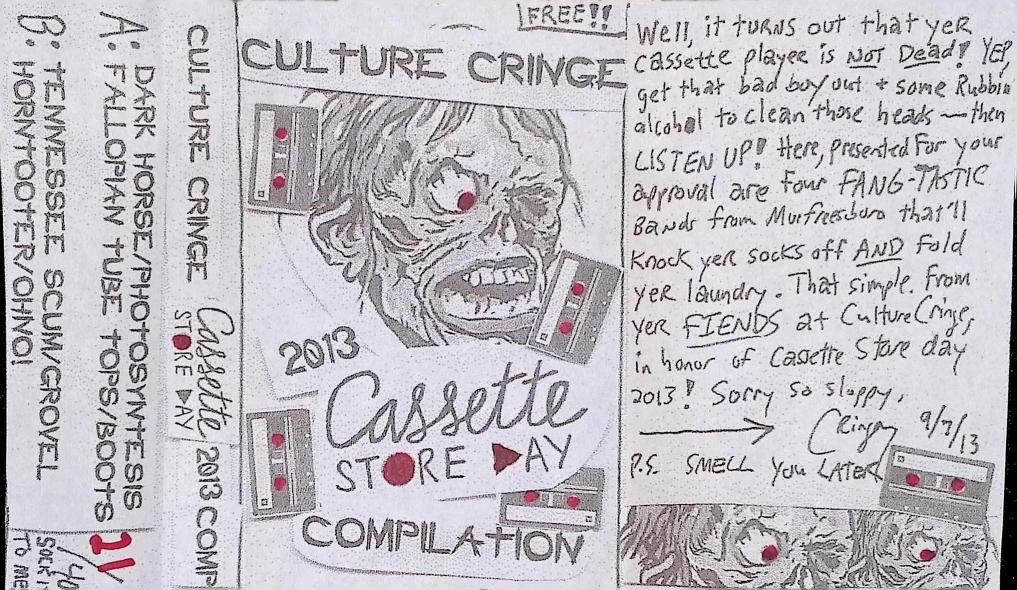
In case you haven’t noticed, young people today have a newfound love for cassettes. Tons of notable artists, like Taylor Swift, Billie Eilish, or Harry Styles, have been releasing some of their most recent albums on cassette, despite the existence of modern alternatives. In  an indie-published magazine called Culture Cringe from 2013, we can see the author is encouraging the readers to get out their old cassette players in honor of “Cassette Store Day.”1

Culture Cringe promoting Cassette Store Day, 2013

Why do young people today, most of which weren’t around for the height of the cassettes popularity in the 1980s, have a love for cassettes?  Professor Joanna Demers from the USC’s Thornton School of Music provides one perspective that this revival of cassettes is not one of pure nostalgia, because of course young people weren’t around for cassettes in the ‘80s, but a creation of a fictional nostalgia for creating and experimenting with playlists and mix-tapes.2 There could be many arguments made for why cassettes are experiencing a revival in American music culture, but at the core of this discussion is that fact that cassettes have never really died in the first place. The use of cassettes, whether it’s to share, create, or listen to music, continues to reflect and shape American’s tastes, values, and experiences. 

  1. Culture Cringe. Culture Cringe Cassette Releases. Self-published, 2013. https://archive.org/details/culture-cringe-cassette-releases_202502/page/n5/mode/2up. ↩
  2.  Joanna Demers. “Cassette Tape Revival as Creative Anachronism.” Twentieth-Century Music 14, no. 1 (2017): 109–17. https://doi.org/10.1017/S1478572217000093. ↩

Mix-tapes

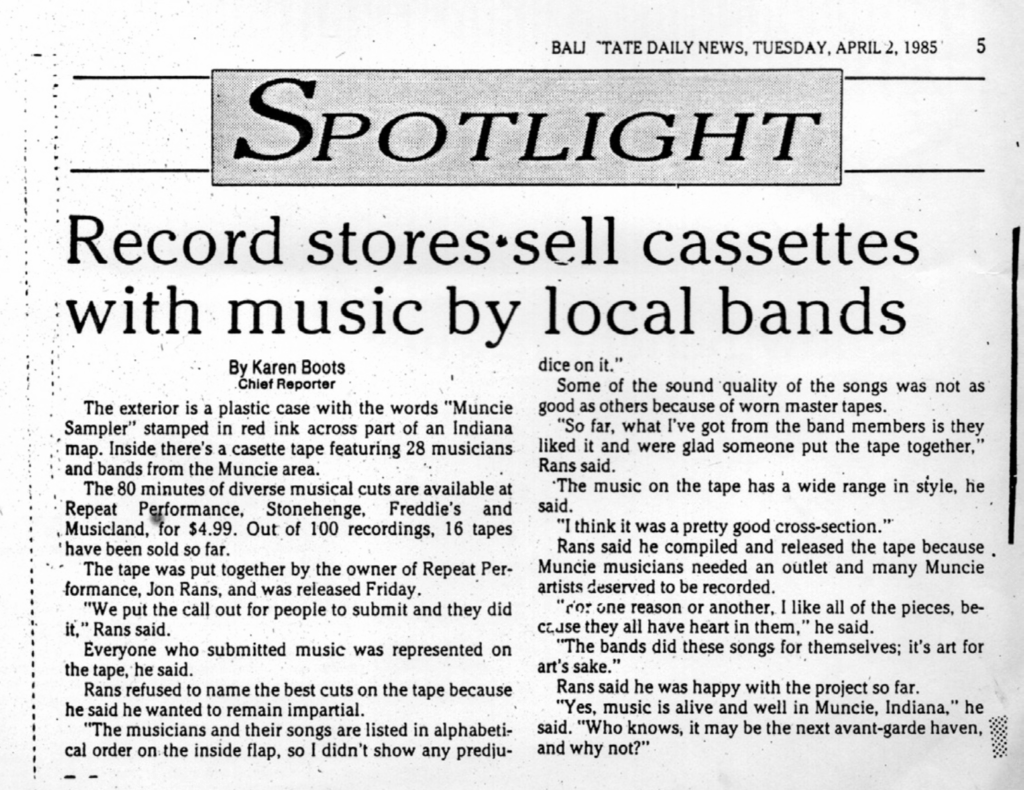
Cassettes did not only offer consumers more portability of their music, but it allowed them to customize the music listening experience in a way that could never have been done before by making mix-tapes. Mix-tapes are compilations of songs recorded onto a cassette, creating a personal playlist of songs rather than only listening to a certain album. This transformed the way we consume and share music. Peter Catlin, a librarian at the University of Mary Washington, described his experience with mix-tapes as his most favorite memory of cassettes, equating mix-tapes to a form of art and self expression1

A newspaper article about record store selling mix-tapes of local bands, Tate Daily News, 1985

Mix-tapes not only shaped the individual or collective music listening experience, but they also allowed musical artists and entire genres of music to grow and influence the American music industry. An example can be found in an article from an Indiana newspaper, the Ball State Daily News, from 1985, which shares with the local community that a record store in the area was selling mix-tape cassettes with music made by local bands.2 The reporter, Karen Boots, writes that the store owners expressed that “[Muncie] musicians needed an outlet and many [artists] deserved to be recorded.”3 Mix-tapes offered people across the country, not just those with prior connections to the music industry, the opportunity to share their art with the world. Mix-tapes and cassettes not only helped individual bands and artists, but they’re credited with launching the hip hop genre, one of the most popular and influential music genres in American history. As quoted in Unspooled: How the Cassette Made Music Shareable, DJ Bobbito Garcia says, “Cassettes were hip hop […].”4 Many hip hop artists got launched their careers off from the success of their mix-tapes. Even when they had signed record deals, artists still released mix-tapes to promoted current projects or releases music in between albums.5 Mix-tapes were integral to the growth of such a culturally significant genre that reflects and shapes American culture to this day.

  1. You can see Mr. Catlin’s full interview here.
    NOTE: Full interviews will not be available until our documentary releases on November 11th, 2025.
    ↩
  2. Karen Boots. “Spotlight Record stores sell cassettes with music by local bands.” Ball State Daily News, April 2, 1985. https://dmr.bsu.edu/digital/collection/NoBarGBChaosR/id/239 ↩
  3. Karen Boots. “Spotlight Record stores sell cassettes with music by local bands.” ↩
  4. Rob Drew. Unspooled: How the Cassette Made Music Shareable. Durham, NC: Duke University Press, 2024, 131. ↩
  5. Rob Drew. Unspooled: How the Cassette Made Music Shareable. Durham, NC: Duke University Press, 2024, 134. ↩

Digital Music

The rise of the internet in the 1990s and 2000s meant that a new landscape to buy, sell, and listen to music opened up. People started experimenting with music downloading and streaming as early as the 1980s. One example is Frank Zappa who sent music over cable networks for consumers to record onto cassettes.1 Another is Jim Griffin who in 1994 gave subscribers of CompuServe the chance to download an Aerosmith track to their computers.2 The issue that initially prevented digital music from taking off was that file sizes for music at the time were far too big for computer hard drives to handle.3

The mission to solve this issue was taken up by a German, Karlheinz Brandenburg, who in 1993 got his algorithm for digital music, the MP3, approved by the Motion Picture Experts Group (MPEG).4 MP3s allowed for mass use of digital music by reducing the size of the file, but to do this, the algorithm removes excess sounds that aren’t as detectable by the human ear compared to louder parts of the track.5 Compared to the compact disc (CD), the MP3 largely reduced the size of music, allowing consumers to store more music than ever before. Consumers could now download music from the internet and even from their own CDs. MP3s were very popular among young people for reasons very similar to why people loved the cassette. You could compile your own set of music personalized to you and take it wherever you wanted to go. The edge MP3s had over cassettes in the 90s and 2000s was that it was easier, could hold more, and, like the CDs, more long-lasting in sound quality compared to the cassette.

  1. Howie Singer, and Bill Rosenblatt. “Downloads.” In Key Changes. New York: Oxford University Press, 2023. https://doi.org/10.1093/oso/9780197656891.003.0008. ↩
  2. Howie Singer, and Bill Rosenblatt. “Downloads.” In Key Changes. ↩
  3. Howie Singer, and Bill Rosenblatt. “Downloads.” In Key Changes. ↩
  4. Howie Singer, and Bill Rosenblatt. “Downloads.” In Key Changes. ↩
  5. Howie Singer, and Bill Rosenblatt. “Downloads.” In Key Changes. ↩

Compact Discs

The compact disc (CD) was developed simultaneously by Royal Philips and Sony in the late 1970s and then was introduced to the public in 1982.1 In creating the CD, the companies wanted to provide consumers with a product that could hold more minutes of listening time compared to the cassette.2 What set the CD apart from something like the record or the cassette was that it used the concept of having groves that you would find one a vinyl record or tape, but developers reduced the size and digitized the groves using Pulse Code Modulation (PCM).3 Sony also released the first ever CD player, contributing to it being the most successful audio technology by the 1990s.4

The CD rivaled the cassette in the height of the cassettes popularity with the introduction of the Walkman, also in the late 1970s. The CD had the characteristics people loved about the cassette: it was portable, simple to use, and allowed users to have more control over their listening experience. In addition to this, the CD had a better, more clear sound and was able to maintain it’s original sound longer than the cassette or record.5 CDs became a major money maker for this corporations, becoming more very popular, but seeing as cassette sales still remained largely successful throughout the 1980s and 90s6, they ultimately didn’t replace the cassette entirely.

  1. James Hill. “A Brief History of Music Formats.” UnifiedManufacturing, January 16, 2022. https://www.unifiedmanufacturing.com/blog/a-brief-history-of-music-formats/. ↩
  2. Howie Singer, and Bill Rosenblatt. “Compact Discs.” In Key Changes. New York: Oxford University Press, 2023. https://doi.org/10.1093/oso/9780197656891.003.0007. ↩
  3. Howie Singer, and Bill Rosenblatt. “Compact Discs.” In Key Changes. ↩
  4. Howie Singer, and Bill Rosenblatt. “Compact Discs.” In Key Changes. ↩
  5. Howie Singer, and Bill Rosenblatt. “Compact Discs.” In Key Changes. ↩
  6. Refer to Success of the Cassette: The Walkman ↩

Success of the Cassette: The Walkman

The cassette was revolutionary in audio and recording technology due to its compact size and mobility capabilities. Compared to the radio, cassettes gave music listeners more control over the music they listened to, and made it more practical to listen to your favorite album or artist on the go. The mobility of the cassette is largely what made it so successful, which was only elevated by the invention of the Sony Walkman in 1979.1

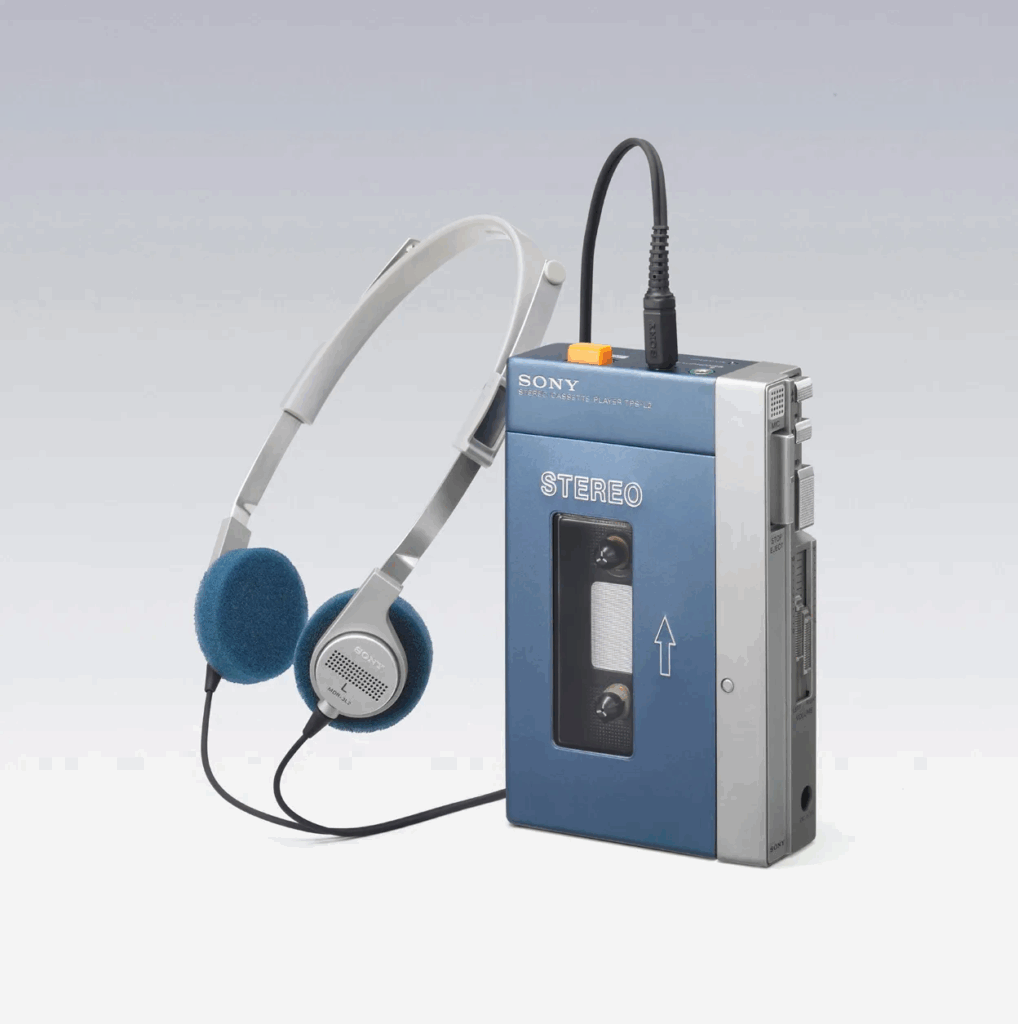
The Sony Walkman, “TPS-L2” model

The Walkman is just about the size of a compact cassette and is accompanied by a pair of headphones for users to listen to their music individually, on the go. 

The Walkman was created by Sony chairmen Masaru Ibuka and Akio Morita who saw an open market for portable music listening devices due to the fact that before 1979 the main ways of listening to cassettes were home or car stereo systems.2 The original version of the Walkman (‘TPS-L2’) set itself apart from the conventional tape recorder because it used stereo circuits and light weight headphones, which offered music listeners the opportunity to create a unique, individual music-listening experience.3 It was a huge success all across the globe, selling 186 million units of the cassette version from it’s launch in July 1979 to 1998.4 The Sony Walkman made cassettes that much more successful and solidified them as an iconic piece of music technology in the twentieth century.

  1. David Pierce. “Sony’s Walkman Turns 35: The Gadget That Started It All.” The Verge. July 1, 2014. https://www.theverge.com/2014/7/1/5861062/sony-walkman-at-35. ↩
  2. Sony Corporation. “Sony Celebrates Walkman® 20th Anniversary.” Sony Group Portal, July 1, 1999. https://www.sony.com/en/SonyInfo/News/Press/199907/99-059/. ↩
  3. Sony Corporation. “Sony Celebrates Walkman® 20th Anniversary.”  ↩
  4. Sony Corporation. “Sony Celebrates Walkman® 20th Anniversary.”  ↩