
This is an old revision of the document!
Table of Contents
Remember to include your name to claim your comments.
Pursell Reading
What is technology? (How does that definition (or at least the examples of it) change in different eras and places?)
Technology is man-made things created to attribute to a practical purpose. In different eras and in different places the definition of practical purpose change so what technology is needed is changed for that area. Example, Florida needs specific things to help recover or prevent hurricane damages, while Maine can focus more on things to help snowstorm recovery. —James Clayberg
Technology is any machine or tool that was created for a purpose for a common good or thing people needed solved or wanted created from scientific knowledge. The definition changes on the time and place because technology is created based on need. For example in the ancient era in Europe or Asia they would of been tools to make farming and life easier, in the 18th and 19th century it was all about industry and transportation so machines to speed things up and creations like trains and steam engines helped transport things way faster, and for today it is all about systems with hardware and software like AI and phones. - Will Crane
Technology is an actant, i.e. a non-human agent that participates in networks of relations. The definition of technology strongly depends on a particular discourse, épistème, or/and habitus. For instance, the Heideggerian notion of technology as Gestell (enframing/a mode of revealing) which turns beings into “standing-reserve” (resources to be taken, exploited, ordered) was shaped by German interwar debates regarding the role of technologies in modernity. (the horrors of the WWI, industrialization of society, etc) - Nikolai Kotkov
Technology is something created for a specific purpose. Throughout different eras, that definition has adjusted to how society has developed. Early technology was something that could make a task more efficient, such as an axe or a scythe. Now, technology evolves alongside the technology of the past, and is often directed by the needs of humanity. - CJ Nemetz
Technology is the use of tools, techniques, and systems to solve problems or achieve goals. Its definition shifts depending on era and place. In ancient times, it could mean farming tools or writing systems, while in today's definition, it might refer to computers, AI, or biotechnology. What counts as “technology” often reflects on the society's needs and resources. – Caitlyn Edwards
Technology is something that is made by humans to make their lives easier and that allows for the development of their society (both good and bad). The definition of technology changes from period to period depending on the needs of the society at the time, as well as the resources they have to be able to “invent” new technology. As we've seen in history, technology development started slow and basic, with axes and wheels and knives, but has exponentially evolved to robots, rocketships, AI, and more. - Oliver Marcel
Technology is any tool that is created in order to assist people in reaching a goal. Technology can vary and change depending on the era or area that it exists in, since the people in different times and places have different needs as well as different materials available to create new technology. For example, agricultural tools like the hoe and sickle were created during a time when there were significantly less people in the world who needed to be fed, so therefore they were not able to harvest very many crops at a time. Current agricultural technology has evolved to be much more efficient at harvesting mass amounts at a time, since today’s society has a higher population as well as a much larger market that the food will be going towards. - Noah Rutkowski
Technology is the application of a tool, technique or system to streamline tasks or solve problems. In the same way that technology can aid society, it can also be harmful. The definition of what technology is changes from place to place and time to time, typically to accommodate the advancement of technology or society. For example, when we refer to computational technology now, we typically are referring to our personal devices, or advanced mathematical computers and calculators. An ancient Greek however, if referring to computational technology, probably would have been referring to something like an abacus. - Abby Firestone
Technology is a tool created to make some sort of process easier whether it’s by saving labor or taking steps out of a process. It can have positive, negative, and unprecedented impacts across all times and places. What we commonly think of as technology changes over time from physical tools and machines to digital technology. - Grayson Donohoe
Technology is a man made tool, system, etc. that is created to improve something whether in a practical or more complicated sense. Technology is continuously changing and evolving as we learn from our history. As technology evolve, it grows upon the last invention or method that was being used. For example, a dish washer, it’s a machine that washes your dishes for you so that you don’t have to wash dishes by hand. - Izzy Ellenberger
Technology is a tool created by people for a specific purpose or goal, although these tools do not always have the desired effects they were designed to produce. The definition of technology has changed over time because people have viewed it differently. In different places, people have various needs that are demonstrated by popular technologies and see technology through their own lenses. For example, children were once thought not to be technologically capable, but that has shifted and now in America it is widely believed that only young people can truly master technology. - Hannah Holstrom
Technology is the creation of tools for practical purposes, meant to advance or improve our everyday lives. Throughout our history, technology has evolved with our understanding of science and available resources. Different places and cultures might prioritize different aspects of life, thus tools made for specific needs may have technologically advanced much sooner than others. - Izabella Martinez
What is culture?
Anything that informs the collective identity and history of a group. — Philip J. Stover
Culture is the culmination of various beliefs, views, and habits of a population of people. - Justin Hoskins
Shared behavior that a population (not just human) can have and usually can be passed down through generations. –James Clayberg
I like Clifford Geertz’s definition that culture “is best seen not as complexes of concrete behavior patterns—customs, usages, traditions, habit clusters—but as a set of control mechanisms—plans, recipes, rules, instructions.” - Nikolai Kotkov
Culture is the shared beliefs, values, practices, and artifcats that shape how a group of people live and interact. It includes language, traditions, art, and social norms. Culture evolves over time and differs across communities. — Caitlyn Edwards
Culture is a set of ideals, beliefs, and ways of a group of people - CJ Nemetz
Collective, learned, and shared behaviors, values, and understandings - Oliver Marcel
Culture is a set of common attributes such as language and traditions that are shared between members of a group, which is often geologically, religiously, or identity based. - Noah Rutkowski
Culture is the combination of shared behaviors, values, and histories that influence the identities of a group of people. Culture can (but doesn't always) include things like language, tradition, etiquette, or art. - Abby Firestone
Culture is a collection of ideas, beliefs, and traditions shared amongst a group of people. - Grayson Donohoe
Culture is a group of people that share the same beliefs, values, and traditions. - Izzy Ellenberger
Culture is the defining elements of a group of people, their values, ideas, traditions, music, fashion, etc. - Hannah Holstrom
Culture is the culmination of a shared set of beliefs, customs, practices, and traditions that define a group of people. Culture is something that can be passed down through generations. - Izabella Martinez
What is technological determinism? (according to Pursell)
The assumption that technology is responsible for determining what happens in society. –James Clayberg
The thought that technology is going to change our life and we need it. This is used by many marketers to try to get you to buy the new product as its “life changing”. - Will Crane
It is a philosophical concept that postulates that all technology is “the base” or “substructure” (in Marx’s sense) that provides the foundation for the development of society as a whole. According to Pursell, it is “the assumption that technology determines what happens in society.” - Nikolai Kotkov
Technological determinism is the idea that technology drives social and cultural change, often shaping human behavior and history more than human choices do. It suggests that once technology is created, society adapts to it. Critics argue that this view overlooks human agency and social context. —–Caitlyn Edwards
The idea that technology determines what happens in life - CJ Nemetz
Technological determinism is the incorrect assumption we often make that new technological advances will positively influence and change our experience in society. - Noah Rutkowski
The idea that human's are more influenced by technology than technology is influenced by humans. - Oliver Marcel
The assumption that our actions (and the future) are determined by the technology we have access to. - Abby Firestone
From Pursell’s perspective, it is when we assume that technology will determine what will happen to/in society, but society also determines what happens to technology. - Grayson Donohoe
Pursell describes technological determinism as the assumption that technology determines what happens in society, and how, it’s easy to fall into the understanding of this to be true. - Izabella Martinez
Classroom Technology Infographic -- How might we critique this as a source?
How can we determine when something was invented if it took however many days or even years for it to be developed? Furthermore, the infographic does not cite any sources, so, for all we know, the information could be made up. If there ever were a collection of sources for the image, it no longer exists, as the link in the article leads to a deleted page. — Philip J. Stover
I disagree with the term “evolution,” which implies an inevitable progressive movement from a blackboard to virtual reality. In my opinion, C. Pursell is correct in saying that technologies do not “grow out of their own logic,” because they are always subjected to a particular paradigm (alternative technologies, historical contingency). - Nikolai Kotkov
Infographics often simplify complex information, which can leave out nuance or critical perspectives. They may lack citations, making it difficult to verify accuracy. As a source, it’s useful for quick visualization but weak for in-depth or scholarly analysis. —- Caitlyn Edwards
This infographic is lacks citation to ensure accuracy and is not aimed as a scholarly source of information. It does not demonstrate any relation between the different objects and perhaps how they shaped each other's development. Furthermore, many of these technologies are still in use (blackboards, whiteboards, calculators, etc.) which, in conjunction with the term “evolution”, makes it seem like these technologies are outdated and are no longer useful.
Not only is this infographic lacking citations, context, and further information, but there also doesn't seem to be any real rhyme or reason for the things that they put in it. The dates are all over the place, there's no theme to the technologies, and it's just a bad infographic in general. - Oliver Marcel
Because the infographic is so simplified, it cannot accurately portray the actual spread and usage of these technologies. It is very likely that large portions of the world did not have access to these new technologies, whether that be because of class disparity, location, or anything else that may have prevented certain populations from having easy access to new inventions. - Noah Rutkowski
This info-graphic not only lacks citation and the necessary context to actually describe the changes in classroom technology from 1860 to 2015 (and on); the info-graphic also is hopelessly vague about much of the technology it describes, how that technology was used, and why it was implemented. It implies that the progression of blackboard to VR is / was inevitable, but also that all of these devices were made widely used and easily accessibly in the years listed, which is an inaccurate assumption. - Abby Firestone
While I think infographics, like this one, can show a simple progression and change over time, it does lack more of the history and context behind those changes, what led to them, and what prompted them due to the lack of space for longer sentences and paragraphs. - Grayson Donohoe
Technological determinism is often interpreted in the way that technology determines changes in society. It is often used as a selling point in companies. For example, a company could be selling a vacuum and will advertise it to be life changing, and if you don’t get it then nothing will change. -Izzy Ellenberger
Generate a meme that captures your excitement or concerns about first week of classes (search "meme generator" if you haven't created one before and bonus points if you can embed it (hint, see [[wiki:syntax|syntax]] or look at how I posted mine)
 – Dr. M
 - Grayson Donohoe
 — Philip J. Stover
a488l8 –James Clayberg
 – Izabella Martinez
 –Justin Hoskins
a49b64 – Wil Crane
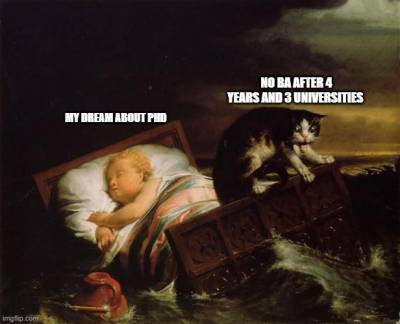 – Nikolai Kotkov
 —–Caitlyn Edwards
 – CJ Nemetz
a4c5ed – Oliver Marcel
 – Ava Bredehoeft
a4cbhl - Noah Rutkowski
a4cr4b – Abby Firestone
 - Izzy Ellenberger
_QTdgDEXY2 - Todd Holman
 -Hannah Holstrom